

















The elections held on November 4th, 2025 broke records having a clean sweep of Democrat wins across the board. Soon thereafter, a majorly Democratically supported bill about redistricting, Proposition 50, has been passed in California and is bigger than you think.
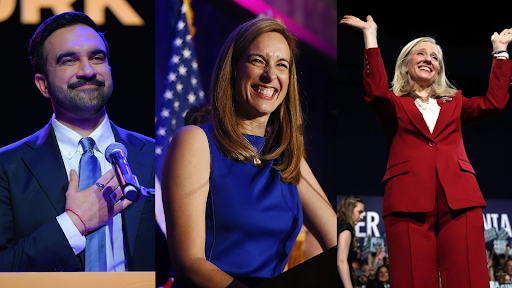
In the election for governor in the state of Virginia, female democrat Abigail Spanberger won with 57.6% of the votes. Besides winning governor, Spanberger also made Virginia history by becoming the first female elected governor in the state’s record. As a previous U.S. representative and CIA officer, Spanberger has been in the world of politics for a long while and knows her way around. She will be sworn in as Virginia governor in January 2026.
Similarly, in the gubernatorial election for New Jersey, female Democrat Mikie Sherrill took over with 56.9% of the votes, becoming the first female Democratic governor in New Jersey history. Former federal prosecutor and naval officer, Sherrill is known for having a tough and determined demeanor and is also set to be sworn in as the New Jersey Governor in January 2026.
Finally, the New York City mayoral election gained lots of traction, especially online, due to the presence of the young Democratic socialist candidate, Zohran Mamdani. Accumulating 50.8% of all votes, almost an entire 9% above his runner-up, Andrew Cuomo, Mamdani won the election and is set to be sworn into office in January 2026. As an immigrant from Uganda, Mamdani brings new ideas and perspectives to debates that many young adults can relate to.
Along with this Democratic swing, the Democratically supported bill, Proposition 50, was passed and is set to redistrict the state of California until the 2030 census.
Back in the 2020 redistricting cycle, as a part of the decennial census, there was a lot of partisan redistricting, or biased redistricting favoring a specific political party, also known as gerrymandering. The reason for redistricting is to set the seats of the House of Representatives that states will receive for future elections: 435 seats split among the 50 states to determine the electoral votes a state has. This gerrymandering in 2020 was “bad” because it mostly favored the Republican party, unfairly balancing the votes between parties. For example, in Texas, the gerrymandering resulted in two new districts, creating five new Republican seats in the House and bringing their electoral vote total to 40. Many saw this as partisan redistricting for the Republican party and an erasure of Democratic voters specifically sectioned in smaller districts.
Gavin Newsom, Democratic governor of California since 2019, proposed Prop 50 in order to offset the gerrymandering in the state of Texas. While many critics label this as “Democratic gerrymandering,” it actually cancels out the partisan votes gained by Texas in 2020. Further, Prop 50’s redistricting strategy is called independent redistricting, meaning that the new map is drawn by nonpartisan or bipartisan committees made of political independents. This bars politicians from gerrymandering for their own political party and favors the voters.
However, Prop 50 is only temporary. These new map lines will only last until the 2030 decennial census, when the government does their own rounds of redistricting.
Now, it has been a month since this blue wave of commotion; what has happened since then?
Well.. kind of nothing.
In technical terms, we are currently in the transition period of the elections, as Mamdani, Sherrill, and Spanberger are all set to be sworn into their positions come January 2026 are not officially “active” in office. However, they all have big plans for their respective states and cities, ultimately setting up a good foundation for immediate action on January 1st.
Mikie Sherrill has big plans that align with her belief in accountability and oversight as the most important qualities for government. In a local interview, she states, “strong accountability and oversight are essential to ensuring good governance and public trust. The people of New Jersey deserve nothing less.”
Similarly, Sherrill has already announced the creation of a bipartisan Local Government Advisory Group of elected officials across New Jersey to help with the Governor transition and ensure the citizens of New Jersey have a voice in the upcoming administration. This focus on improving the transitional period of governors is a key concern in Sherrill’s agenda as she continues to add committees and real citizen opinions to help shape a more efficient government in New Jersey.
As for Abigail Spanberger, she has a clear outline for Virginia’s future. Her main goal is affordability, specifically for housing, healthcare, and energy costs. Spanberger also plans to support the workforce and provide resources to compete in the business world. Apprenticeship classes in schools, real-world applications, and paid family and leave programs are all ideas Spanberger plans to initiate once officially sworn into office. As governor, her goals for Virginia’s future are very business focused, and she wants to further improve the state’s economy.
Spanberger’s approach to applying these new plans is one of practicality. Spanberger prides her campaign as one that is “unflashy” and practical, solving problems efficiently and simply. She wants to stray away from the chaos of national, partisan politics and focus solely on Virginia’s best interest.
Finally, Mamdani, similarly to Spanberger, wants to mend the affordability issue in New York, specifically, the housing crisis and the rise in homelessness. Some of his other promises include free, universal healthcare for children ages 0-5 and providing free public transportation. However, for all these plans to be implemented, government funds are needed to fill in the gaps that Mamdani does not want citizens to pay. To create those funds, he plans on increasing taxes on large corporations and the wealthy class. Yet, critics claim he is too ambitious with his promises, stating the funding gaps cannot be filled.
Thus, January 2026 will mark the swearing in of Sherrill, Spanberger, and Mamdani, as well as the initial actions of Prop 50. The November 2025 elections are a major Democratic win that will leave a mark on history. So, continue expanding your worldview through state and national elections and become involved! Who knows? Maybe you will be the one voting next November in Wisconsin.